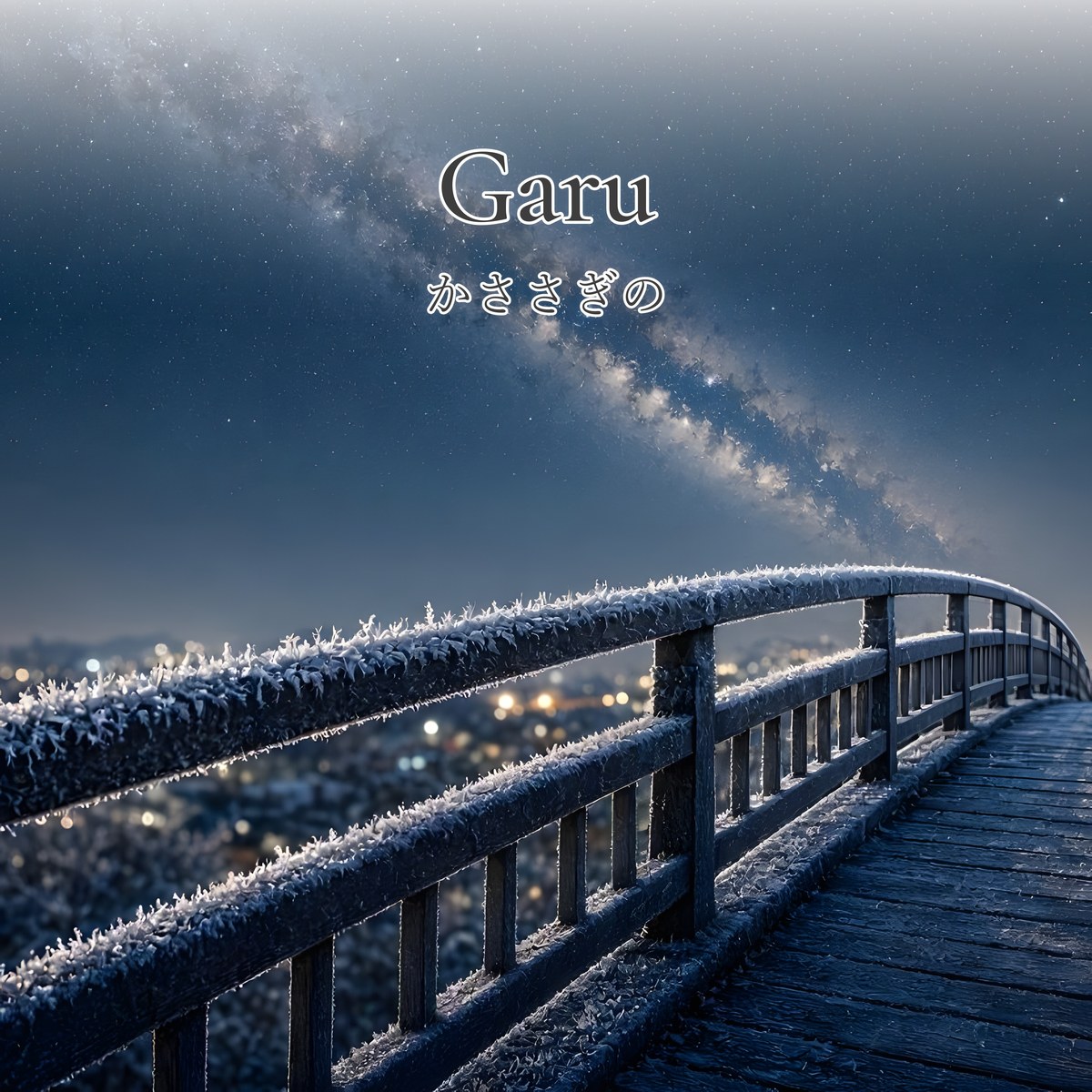
The bridge the magpies are said to spread across the River of Heaven — seeing the white frost settled on the palace stairs, I know the night has grown very late.
Chūnagon Yakamochi — Ōtomo no Yakamochi — was a poet of the Nara period, said to be the one who gave the Man'yōshū's twenty books their present form. Born into the great Ōtomo clan, he went north to serve as governor of Etchū, and died late in life in Mutsu; his was also a life spent watching his clan pushed aside in one political struggle after another. Yet this poem appears nowhere in the Man'yōshū. It stands in the winter book of the Shin Kokin Wakashū under the name 'Chūnagon Yakamochi', so it is likely that later generations entrusted it to him as a poem worthy of his name. The poem borrows the Tanabata legend: once a year, magpies line up their wings and build a bridge across the River of Heaven — and on that bridge, frost is lying. Tanabata belongs to summer and early autumn, but frost belongs to winter. The two seasons stay layered, and neither breaks the other. There is also an old reading in which the steps of the imperial palace are likened to the 'bridge of heaven', so whether this is a bridge in the sky or the one before the poet's eyes is never settled.
At night, he sees frost lying on the bridge. It is white. And seeing it, he realizes how late the night has grown — that is all the poem says. It does not say cold, or beautiful, or lonely. What it holds is only the movement of the eyes in 'seeing its whiteness', and the realization in 'the night has grown deep'. He learns that time has passed from the whiteness of frost. People sometimes know the hour not from a clock but from something like this. And the birds said to have built the bridge are no longer there. Only the shape of the bridge remains, in white.
What drew us to this poem is that it says time has passed with nothing more than 'the frost is white'. So in the lyrics, too, we never explain the passing of time; we draw it only with the eyes and the hands. A footbridge over the tracks after the last train, the prints of fingers left on the rail, our own footsteps following a moment behind. In the chorus, 'I look down' comes twice, so that the instant he looks down at the white frost at his feet is the instant he knows how deep the night is. Then the original poem follows: first the realization in today's words, then the landing in words a thousand years old. The other thing we wanted to draw was that the birds who built the bridge are gone. On the night of Tanabata, magpies lined up their wings to bridge the River of Heaven. In place of those wings, frost now spans the bridge, and each grain of it shines like a white feather. Laying white wings over white frost is, we believe, the heart of this poem's imagery. The bridge crossed so many times without knowing its name — by the end, its name is known. A winter bridge crossed alone comes to overlap with the once-a-year bridge of Tanabata, and there the song ends.
かささぎの(新古今集/中納言家持・百人一首6番)Garu JP
かささぎの 渡せる橋に 置く霜の
白きを見れば 夜ぞ更けにける
終電のあと 線路をまたぐ橋 手すりに置いた 指のあとが残る
街の灯りが 下を流れてく 渡りきるまで 誰にも会わない
上を見れば 星が近い
橋の名を 知らないまま
何度も ここを渡ってきた
足音が 遅れて ついてくる
橋の真ん中で 足を止める
目を落としたら
霜が白くて
目を落としたら
夜がふけていた
かささぎの 渡せる橋に 置く霜の
白きを見れば 夜ぞ更けにける
下を 回送電車が 過ぎていく
遠くの窓が ひとつずつ 消えていく
手すりの上に 霜が白い
息を吐けば 雲になる
夜が ふけていく
年に一度だけ 翼をならべて
鳥が架けた 天の川の橋
夏のはずの その橋に
いま 霜が置いている
目を落としたら 霜が白くて
目を落としたら 夜がふけていた
翼はもう ここにはない
橋のかたちだけが 残っている
翼のかわり 霜が架かる
羽根のひとつずつが 白く光る
ひとりで この橋を 今夜も渡る
橋の名を 今は 知っている
目を落としたら
霜が白くて
目を落としたら
夜がふけていた
かささぎの 渡せる橋に 置く霜の
白きを見れば 夜ぞ更けにける
白いところに 手を置いたまま
気づけば 夜が ふけていた
霜の羽根の 橋の上で
夜が ふけていた
On the bridge the magpies spread across the sky, the frost lies white —
seeing its whiteness, I know the night has grown deep
After the last train, a bridge across the tracks; the prints of my fingers stay on the rail
The city lights flow by below; no one passes me until I reach the other side
Look up, and the stars are close
Not knowing the name of this bridge
I have crossed it so many times
My footsteps follow a moment behind
In the middle of the bridge, I stop
I look down
and the frost is white
I look down
and the night has grown deep
On the bridge the magpies spread across the sky, the frost lies white —
seeing its whiteness, I know the night has grown deep
Below me, an empty train passes by
Far-off windows go dark, one by one
On the rail, the frost is white
I breathe out, and it turns into a cloud
The night grows deeper
Once a year, wing beside wing,
the birds built a bridge across the River of Heaven
On that bridge, meant for summer,
frost is lying now
I look down, and the frost is white
I look down, and the night has grown deep
The wings are no longer here
Only the shape of the bridge remains
In place of the wings, the frost spans the gap
each of its feathers shining white
Alone, I cross this bridge again tonight
Now I know its name
I look down
and the frost is white
I look down
and the night has grown deep
On the bridge the magpies spread across the sky, the frost lies white —
seeing its whiteness, I know the night has grown deep
My hand still resting on the white
I realize the night has grown deep
On a bridge of frost feathers
the night has grown deep
Kasasagi no (Shin Kokin-shu / Chunagon Yakamochi, Hyakunin Isshu No. 6) Garu JP